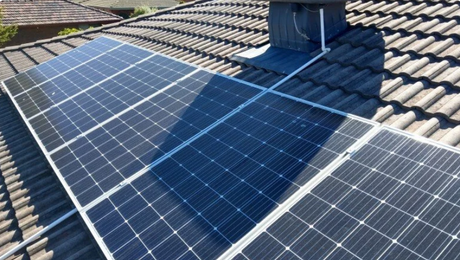


RV solar panels let you camp farther from shore power and run your appliances without a noisy generator—but in Canada, success depends on more than just bolting panels to your roof. Weather, tree cover, battery temperature, and your actual daily consumption all play a role, and winter days give you very little charging window.
This guide doesn't sell you magic. Instead, it walks you through a practical approach to choose the right RV solar panels.
How Do RV Solar Panels Work?
An RV solar system turns sunlight into electricity and stores that energy for later use.
- Solar panels produce DC electricity when exposed to sunlight.
- A solar charge controller regulates that power before it reaches your batteries.
- The battery bank stores energy for use after sunset or during cloudy periods.
- Stored DC power directly runs your RV's 12V equipment (lights, fans, water pumps).
- For standard household appliances, a power inverter converts 12V DC battery power into 120V AC, enabling you to plug in everyday devices like laptops or small kitchen gadgets.

What Does an RV Solar Panel Kit Include?
| Component | What it does | Why it matters in an RV |
|---|---|---|
| Solar panels | Capture energy from sunlight | Determines potential daily harvest |
| Charge controller | Regulates solar charging | Protects and charges batteries correctly |
| Battery bank | Stores usable energy | Keeps power available at night and in cloud |
| Inverter | Converts 12V DC to 120V AC | Needed for many household-style appliances |
| Mounting, cables and protection | Secures and connects the system | Important for weather, vibration and safe operation |
Can I Connect a Solar Panel Directly to an RV Battery?
In most RV solar systems, no. A standard solar panel should not be connected directly to a battery without a correctly sized charge controller. Solar output varies with sunlight and temperature; without a controller, the battery may be charged improperly or overcharged. For a normal RV system, use this order:
Solar panel → fuse or disconnect as required → charge controller → appropriately fused battery connection
The exception is a purpose-built, low-wattage solar maintainer that includes its own regulation. For a normal system, follow equipment manuals, use correctly rated cable and overcurrent protection, and consult a qualified RV or electrical professional if you are unsure.
How Many Solar Panels Do I Need for My RV?
Start with energy use, not roof space.
Daily watt-hours needed ÷ realistic daily solar hours = required solar watts
Then add a practical buffer for charging losses, less-than-perfect panel angle, occasional shade and weather. For Canadian RV travel, sizing only for ideal midsummer sunshine can leave you disappointed in shoulder season.
Example: a typical weekend RV setup
Imagine a couple camping for three days near Tobermory or on Vancouver Island. Their approximate daily use might look like this:
| Device | Estimated daily use |
|---|---|
| LED lights | 120Wh |
| Water pump | 100Wh |
| Roof vent fan | 300Wh |
| Phone and camera charging | 120Wh |
| Laptop | 180Wh |
| 12V compressor fridge | 600–1,000Wh |
| Estimated total | 1,420–1,820Wh/day |
With real-world losses and variable weather, a 200W system may be enough for modest use in good summer conditions, but it may not replenish this entire load every day. A 390W to 400W system, paired with enough lithium battery storage, offers more margin for a fridge, fan and electronics—particularly when clouds or shade intervene.
Roof-Mounted vs. Portable Solar Panels for RVs
Roof-mounted rigid solar panels
Roof-mounted panels are ideal if you want charging to happen automatically while driving or parked. They are a practical fit for Class B vans, trailers and motorhomes that spend plenty of time in open sites. Their drawback is shade: a beautiful, tree-lined campground can shade a roof panel for much of the day.
Portable solar panels
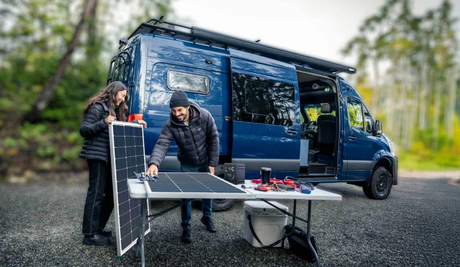
Portable solar panels are particularly useful in Canada because the sunniest patch is not always where you want to park. You can place a portable panel in an open area while the trailer stays under partial shade, provided the cable run is safe and you remain nearby. Never create a tripping hazard or leave a portable panel unsecured in wind.
Flexible solar panels
Flexible solar panels can suit curved or weight-sensitive surfaces, but they need careful mounting and ventilation planning. Treat flexibility as a fit advantage—not automatically as a performance upgrade.
A Simple Way to Choose Your RV Solar Setup
Light-use weekend camper
You want to keep a battery topped up, run lights, a water pump, a fan and charge devices. A 100W–200W panel setup with a properly matched battery and controller may be a sensible starting point.
Frequent off-grid traveller
You run a 12V fridge, spend several nights without hookups and work remotely from the RV. Consider roughly 300W–500W of solar, lithium battery storage, MPPT charging and monitoring. Final sizing should follow your energy audit.
High-demand or extended-stay RV
You run multiple devices, use an inverter frequently or want more confidence through variable weather. A larger array, expanded lithium storage, alternator/DC-DC charging and possibly generator backup may make more sense than trying to solve every need with panels alone. See the Renogy RV Solution range for a more comprehensive option.
Common RV Solar Mistakes to Avoid
| Mistake | A better approach |
|---|---|
| Buying panels before calculating loads | Calculate daily watt-hours first, then size the array and battery bank. |
| Forgetting battery capacity | Make solar generation and storage work together. |
| Ignoring shade | Plan roof layout around vents, racks and likely campsite shade. |
| Assuming rated wattage all day | Allow for angle, weather, heat, dirt, shade, latitude and season. |
| Skipping fuses or cable sizing | Use correctly rated protection and cable management for RV vibration and weather. |
| Treating solar as an air-conditioner shortcut | Design high-demand cooling around real load and runtime data. |
RV Solar Maintenance Checklist
- Wash off dust, pollen, bird droppings and road grime with water and a soft cloth.
- Inspect mounting brackets and roof seals.
- Check cables for abrasion, loose connectors or UV damage.
- Review charge-controller readings for unexpected changes.
- Confirm battery terminals are clean and secure.
- Remove snow gently; do not scrape panel glass with sharp tools.
- Check portable panels and cables before deploying them.
FAQs About RV Solar Panels
Are RV solar panels worth it?
RV solar panels are often worth it for RVers who camp off-grid, use a 12V fridge or electronics, and value quiet daytime charging. They are less valuable for travellers who stay almost exclusively at serviced sites.
How do I hook up solar panels to RV batteries?
Connect the panels to a suitable charge controller, then connect the controller to the battery bank using correctly sized and fused wiring. Do not connect ordinary solar panels directly to the battery.
Can solar panels run an RV air conditioner?
A large, well-designed solar and battery system can run an RV air conditioner for a limited time, but smaller systems generally cannot.
What size RV solar panel kit should I buy?
Choose based on daily watt-hour use, roof space, battery capacity, season and how often you camp without hookups. For regular off-grid travel with a fridge and electronics, many RVers need 300W or more.
Conclusion
RV solar panels give Canadian travellers more freedom, but the best system is not necessarily the biggest one. It is the one that fits your energy use, battery chemistry, travel season and the places you actually camp.
Start with a realistic power audit. Account for shade, shoulder-season weather and the special needs of lithium batteries in cold conditions. Then choose compatible panels, charging equipment, storage and protection hardware. A well-planned system lets you focus less on the next electrical hookup—and more on the view outside the RV door.


![Which Marine Battery is Right for You [2026 Guide]](http://ca.renogy.com/cdn/shop/articles/how-to-choose-marine-battery_5af35244-b269-4d22-8ef2-af84d70386ed.png?v=1777428541&width=460)