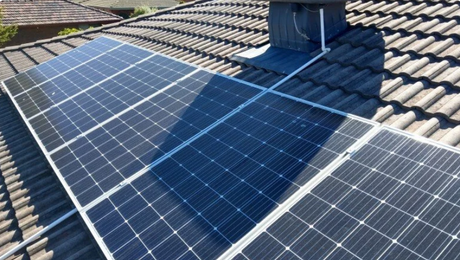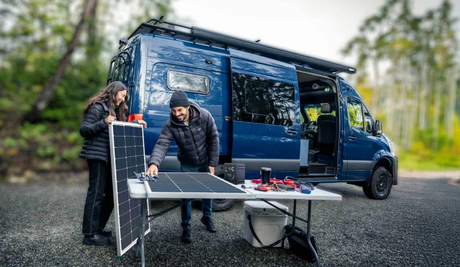


Life on the go can be pretty rough without power. But it doesn't have to feel like you are at the world's worst bootcamp for surviving the post-apocalyptic world. With the right equipment, you can power up your RV to the next level and enjoy the amenities a modern household has. All you have to do is hook up some RV solar panels to your RV or trailer and you can enjoy life on the go even in the most remote locations.
No more worrying about your next shore power top-up or the hassles of dealing with a gas generator. If you have not heard about RV solar panels, don't worry. This article will answer all your questions. Now let's dive in!
What are RV Solar Panels?
RV solar panels are designed for RVs, campers, trailers, and similar mobile homes. They're a great choice when you need to generate solar power in a compact space. For more information on solar panels, check out How To Make A Solar Panel In Canada and How Solar Panels Work.
How Are RV Solar Panels Different from Home Solar Panels?
Not by much, actually. RV solar panels produce less wattage than residential or commercial panels. They're also smaller and easier to install on RVs, campervans, motorhomes, or trailers.
Why Use RV Solar Panels?
Some people even use solar panels for other purposes rather than on RVs because of the benefits they provide. These benefits include:
- Affordability
- Ease of Installation
- Space Efficiency
- Portability
And these are only some of the benefits you enjoy from RV solar panels.

Key Features of RV Solar Panels
As we previously mentioned, RV solar panels are great for compact spaces. Here are the RV solar panels features that make us say so:
- Small Size: Their small size helps you install more panels onto your RV rooftop.
- Portable: Some RV solar panels can be set out in the sun while your RV rests in the shade.
- Lightweight: RV solar panels are easier to maneuver, carry and install on your RV's rooftop.
- Voltage Compatibility (12V): RV solar panels usually have a DC voltage output that's compatible with other DC electronics on your RV. As a result, your solar panels can help power up some of your RV's electronics.
If the different names confuse you, just remember: RV solar panel, trailer solar panel, and solar panel for motorhomes or campervans all mean the same thing.
Types of RV Solar Panels
| Category | Type | Key Features | Advantages | Limitations |
|---|---|---|---|---|
| By technology | Monocrystalline | Small, efficient panels that convert sunlight to electricity very well. | Highest efficiency per panel; smaller and lighter; great for limited roof space. | Generally more expensive than polycrystalline. |
| Polycrystalline | Larger panels with slightly lower efficiency than monocrystalline. | More affordable than monocrystalline; still a reliable choice. | Requires more space for the same power output; lower efficiency. | |
| Amorphous | Flexible, thin, and bendable panels ideal for uneven surfaces. | Lightweight, affordable, and easy to install on curved roofs. | Lowest efficiency; needs much larger area to match monocrystalline wattage. | |
| By usage method | Fixed Installation | Permanently mounted on the RV roof or another fixed surface. | Works while driving or parked; always ready to generate power. | RV must stay in direct sunlight, which can heat up the interior. |
| Portable Panels | Portable solar panels (e.g., suitcase or foldable designs) you can place separately. | Park your RV in the shade while panels collect sun elsewhere; keeps RV cooler. | Limited wattage for portability; cannot be used while driving. |
Note: For more details on folding solar panels, explore our dedicated guides.
How Many RV Solar Panels Do You Need?
To find out how many solar panels you need for your RV, here's what you need to do:
- Step 1: List out all the devices you need to use in your RV
- Step 2: Find the wattage of each device on your list.
- Step 3: Estimate how long you will use each device in hours. For example, if you will use the blender for 20 minutes, then list that time as 0.33 hours (20 / 60 mins).
- Step 4: Multiply each device's rated wattage (usually listed at the back or bottom of your device in Watts) by its running time (in hours) to find the amount of power it uses each day. For example, if the blender's wattage is 500W and it runs for 20 mins or 0.33 hours, it will use 165Wh each day.
- Step 5: Sum up all your devices' power or energy usage for each day to find the total power you use each day.
- Step 6: Take the previous sum in Step 5 and divide it by the product of your chosen solar panel's wattage and number of peak sun hours where you live (Number of Panels = Total Energy Usage / (Panel's Wattage * Peak Sun Hours)).
- Step 7: That's it! The answer you get, rounded to the next nearest whole number, is how many panels you need for your RV.
You can try out different panel wattages to find the RV solar panel that offers you the perfect blend of size, wattage, and price.
If you need an alternative solution to finding how many solar panels you need for your RV, campervan, or motorhome, try using our online solar calculator with an option specifically for RVs.

RV Solar Panel Installation
Once you have chosen your RV solar panels, it's time to roll up your sleeves for the installation.
Installing RV solar panels is not difficult and you can easily do it without calling a professional installer. But if you are not as spry or skilled as you used to be, we highly recommend you seek outside help as no amount of money is worth risking your health.
Here's how to install and use different types of solar panels:
To install rigidmonocrystalline or polycrystalline panels on your RV's roof, you can use brackets that will secure the panels to your roof. Typically, most RV solar panels will come with instructions and tools (bolts, mounts, brackets, adhesive, etc.) you need to install the panel on your roof. Once the panels are mounted on the roof, run a line or wires (positive and negative) from the panels to your inverter according to the instructions that came with your panels.
To install flexible solar panels, use the sticky backside of the panels with adhesive or silicone to stick the solar panels on your RV rooftop or other convenient surface. Once done, run the line from the solar panels to your inverter, taking care to follow any instructions and precautions in your booklet or pamphlet.
Installing and using portable solar panels is easy. All you have to do is set out your solar panels in the sun at an appropriate angle. Run a wire from the panels to your inverter or solar generator. And follow all the instructions and precautions that came with the panels. portable panels are typically foldable like a briefcase. Sometimes, they come with a stand that helps you prop up the panels at an appropriate angle.

Are RV Solar Panels Worth It?
RV solar panels are a worthwhile investment for the right kind of people.
But who are the ‘right kind of people'?
RV solar panels are worth it for you if you fit into one or more of the following descriptions:
- You often stay in your RV, campervan, trailer, or motorhome.
- You like to camp in remote places away from crowded campsites (boondocking).
- You may not have easy access to shore power hookups provided by campsites and other sources.
- You want to replace your gas generator with a cleaner and quieter source of power.
- Find more descriptions in Should I add solar panels to my RV.
If the above descriptions apply to you, we recommend you do yourself a favor and check out our range of solar panels, inverters, and solar generators for RVs.
As with all things, not everyone will find RV solar panels worth the investment. For instance, if you always hook up your RV to shore power or you only use your RV once or twice a year, you might find RV solar panels are an unnecessary expense for you.
That being said, some people in the same situation buy RV solar panels simply for the peace of mind of having a backup power supply for emergencies and when you are traveling. If that's the case, you can spoil yourself with smaller, less powerful, and more affordable RV solar kits.
Recommend: Renogy Complete RV Solar Kit
If you're ready to stop dreaming and start powering your RV with the sun, look no further than the Renogy Go Far 3.8kWh RV Solution. It has everything you need to turn your trusty RV into a solar-powered home on wheels.
What's included in the solar kit:
- 1 × 195W ShadowFlux Anti-shading N-Type Solar Panels
- 1 × 300Ah Mini Size LiFePO4 Battery
- 1 × 2000W Pure Sine Wave Inverter with UPS Transfer Switch
- 1 × 50A DC-DC On-Board Battery Charger with MPPT
- All Required Cables and Mounting Accessories

Why we recommend this solar kit:
- Delivers up to 3.8 kWh per day with just 3 hours of sunlight, plenty for lights, fridge, and device charging.
- All-in-one solution: each component is pre-matched, eliminating the need to guess which part you need.
- Provide a step-by-step installation video to help you set up simply.
- Expandable: the system may expand to meet your changing energy requirements.
We also highly recommend exploring all of Renogy's RV solar kits. We're confident you'll find the perfect solution for your adventure.
Every piece of our solar equipment is carefully designed and matched for RVs, trailers, and other mobile homes. But don't just take our word for it, see what thousands of happy customers have to say about Renogy.


![Which Marine Battery is Right for You [2026 Guide]](http://ca.renogy.com/cdn/shop/articles/how-to-choose-marine-battery_5af35244-b269-4d22-8ef2-af84d70386ed.png?v=1777428541&width=460)